
5 Awesome Zapier Alternatives
 Lukas Mauser
Zapier is the go-to automation tool for connecting apps. With 7,000+ integrations and a dead-simple interface, it's the first thing most people try when they want to automate workflows. But here's the thing: Zapier gets expensive fast. Pricing is based on tasks, and once you're past the free tier (100 tasks/month, single-step Zaps only), costs escalate quickly. Advanced users also hit walls with limited customization, no self-hosting option, and vendor lock-in.
The good news? There are solid alternatives out there. Some are open-source, some are cheaper, and some give you way more control. You can even self-host open-source options like n8n on Sliplane for just €9/month — no task limits, no per-operation pricing.
Let's look at 5 awesome alternatives to Zapier!

1. n8n
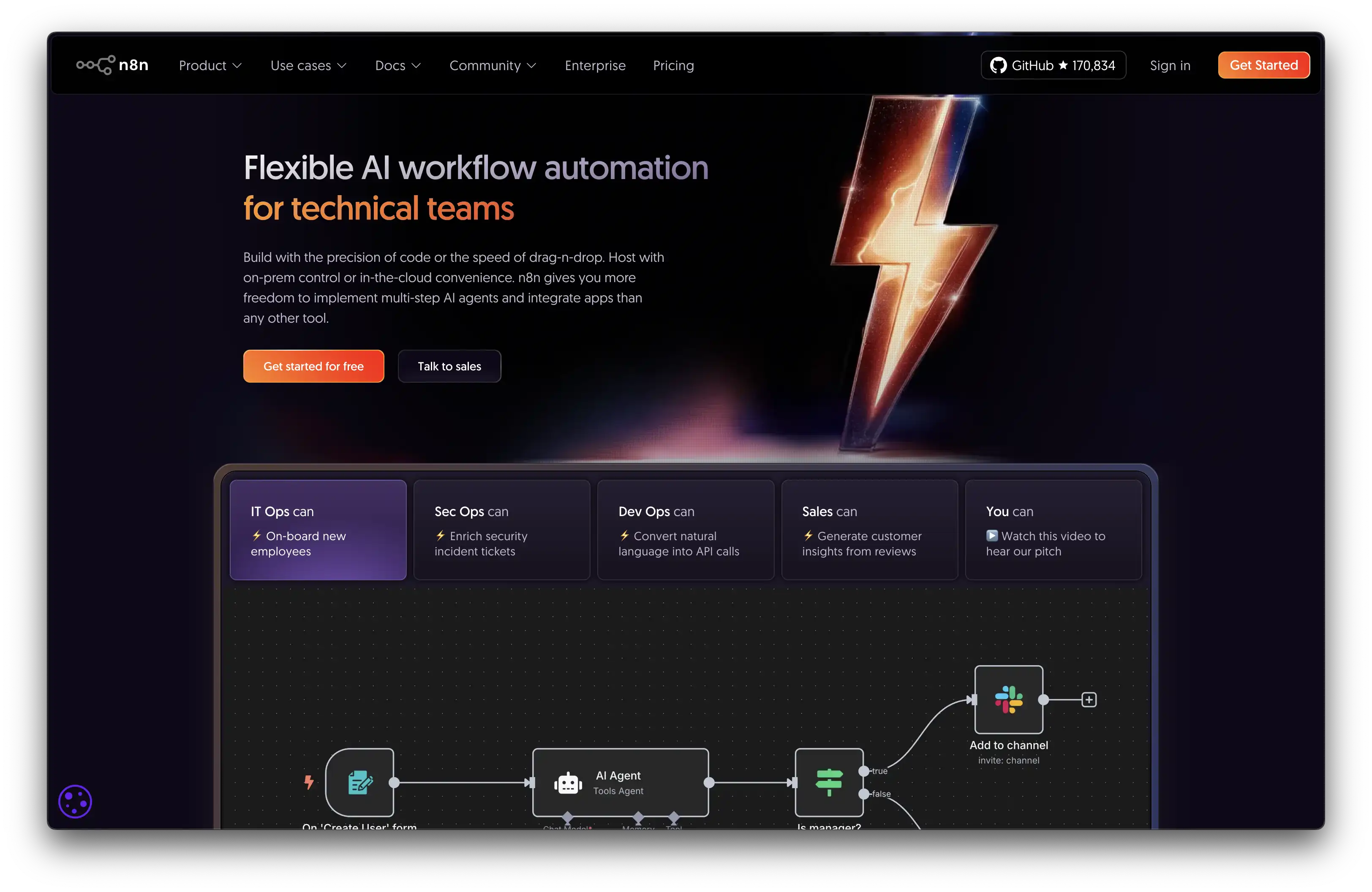
n8n is the most popular open-source workflow automation tool right now. It gives you a visual drag-and-drop builder like Zapier, but with a major twist: you can drop into custom JavaScript or Python code whenever you need more power. It's also AI-native, with built-in nodes for building AI agents and LLM-powered workflows.
The biggest advantage over Zapier? You can self-host it. No task limits, no operation caps. Just your workflows running on your own server. Check out our n8n alternatives comparison for more context, or jump straight to our self-hosting guide.
- Features: Visual workflow builder, 400+ integrations, custom JavaScript/Python nodes, AI agent nodes, webhooks, self-hosting, REST API.
- Why You Should Use It: If you want Zapier-level ease of use with the option to self-host, customize with code, and avoid per-task pricing. The AI workflow capabilities are best-in-class among open-source tools.
- Why Not: Self-hosted requires some server management, the paid cloud plan starts at $24/month with limitations, and the integration library is smaller than Zapier's 7,000+ apps.
- Pricing: Free (self-hosted, Fair-code license); Cloud from $24/month.
2. Make (formerly Integromat)
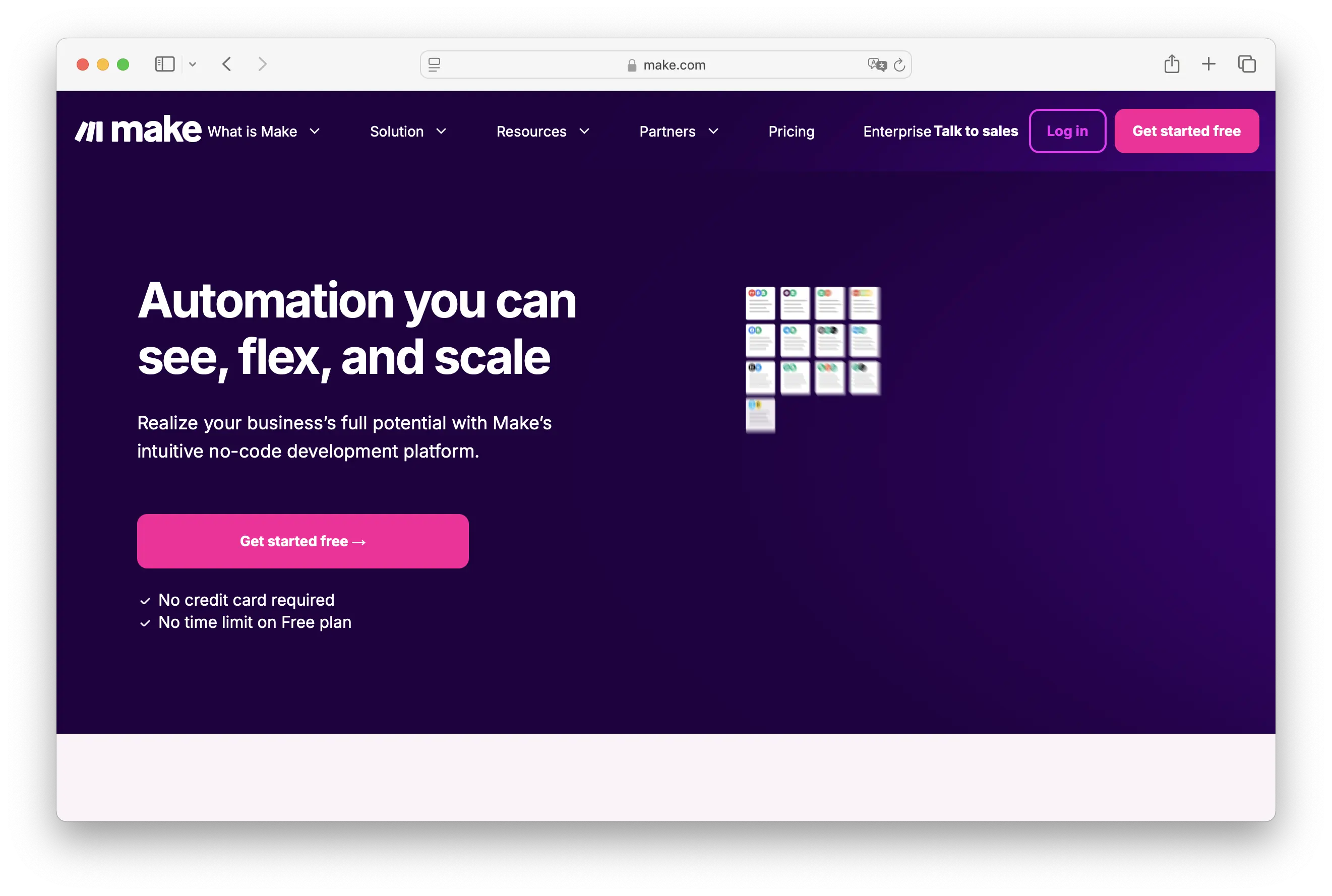
Make is a visual automation platform that gives you significantly more control than Zapier. The workflow builder lets you design complex, multi-branch automations with advanced conditional logic, error handling, and data transformation — all without writing code.
If you've ever felt limited by Zapier's linear Zap structure, Make's visual canvas will feel like a breath of fresh air. You can see your entire workflow at a glance and build intricate logic flows that would be impossible in Zapier.
- Features: Visual workflow builder, advanced conditional logic, error handling, data transformation, 1,500+ app integrations, HTTP/API module for custom connections.
- Why You Should Use It: If you want more control than Zapier without writing code. The visual builder is significantly more powerful for complex, multi-branch workflows.
- Why Not: Pricing is based on "operations" which can still get expensive at scale, there's a steeper learning curve than Zapier, and there's no self-hosting option.
- Pricing: Free (1,000 ops/month); paid from $9/month (10,000 ops).
Self-Host Your Automation Tool
Why pay per task when you can self-host? With Sliplane, you can deploy n8n or Node-RED in minutes for just €9/month — no task limits, no operation caps, no surprises.
3. Latenode
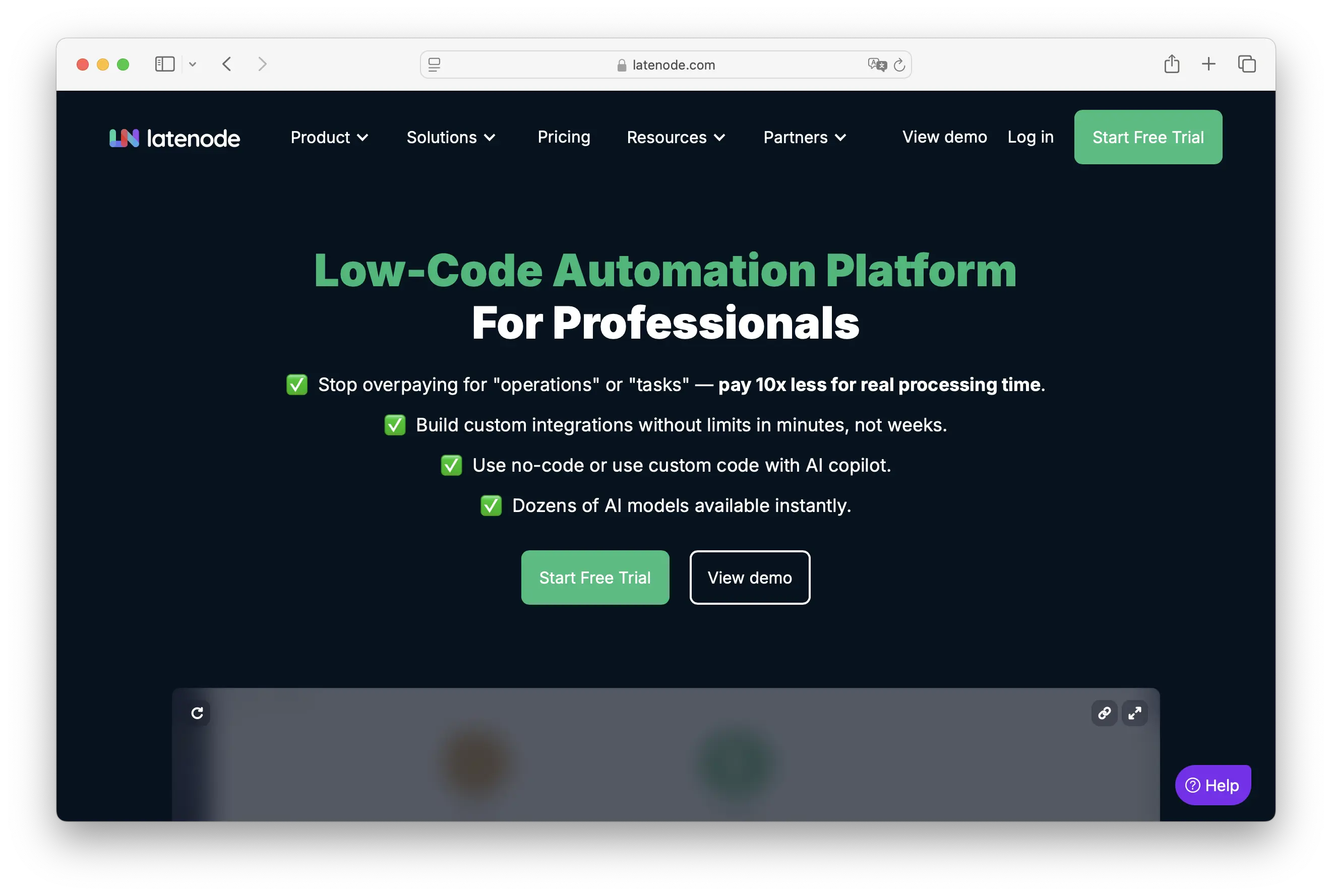
Latenode is an emerging automation platform that blends no-code and low-code with AI-powered features. The standout feature is the AI copilot that can generate custom code for you — so you get the simplicity of a visual builder with the power of custom nodes when you need them.
What makes Latenode interesting as a Zapier alternative is the pricing model. Instead of charging per task or operation, it's based on actual resource usage. That means you're paying for what you actually consume, not some arbitrary task count.
- Features: Visual editor, AI copilot for code generation, custom JavaScript/TypeScript nodes, growing integration library, usage-based pricing.
- Why You Should Use It: If you want AI-assisted automation with transparent pricing based on actual resource usage rather than arbitrary task counts. The AI copilot makes it easy to build custom logic without deep coding skills.
- Why Not: Smaller integration library compared to Zapier or Make, newer platform with fewer community resources, and advanced features still require some technical knowledge.
- Pricing: Free tier; paid from $17/month (usage-based).
4. Pipedream
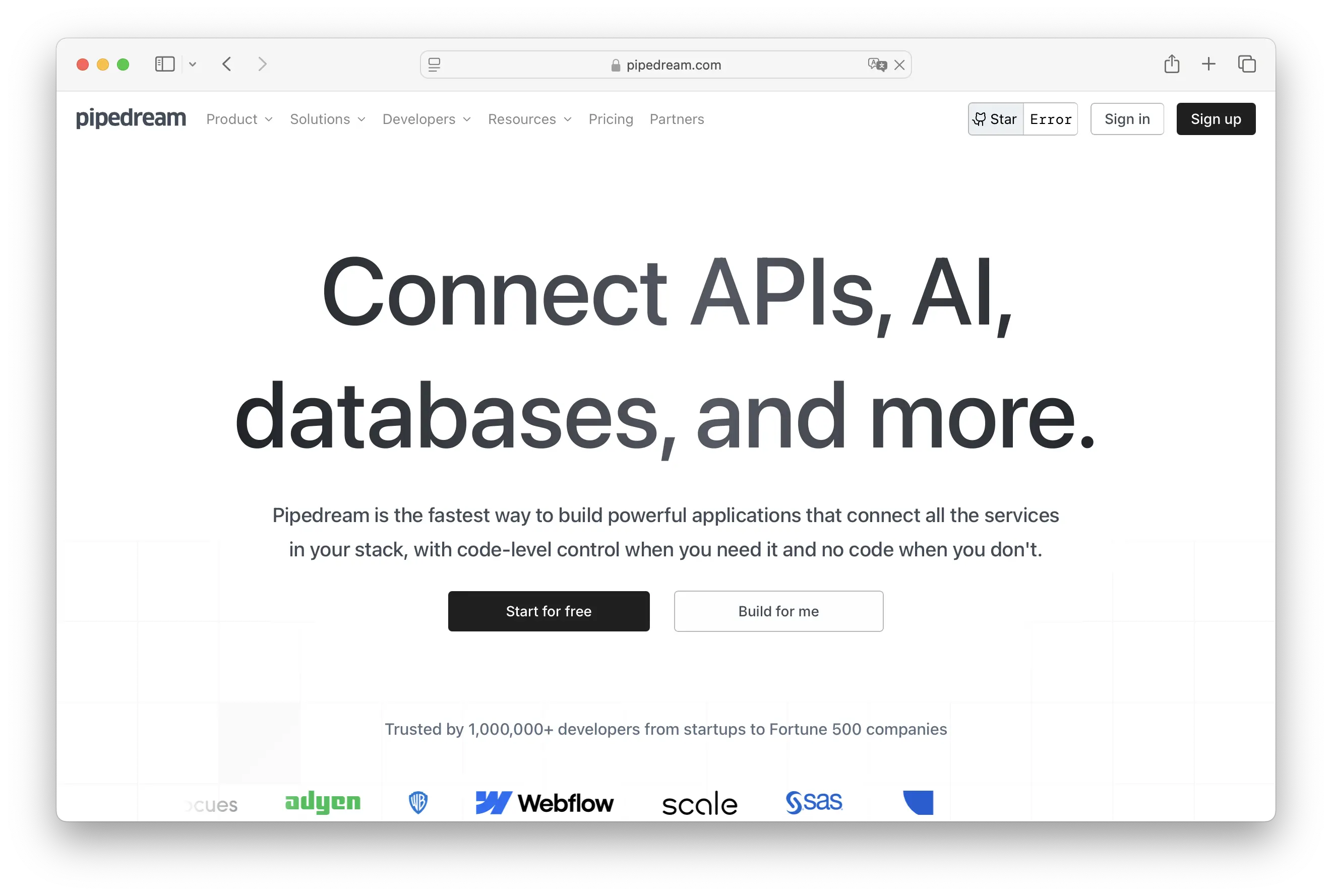
Pipedream is the automation platform built for developers. It combines a library of 1,000+ pre-built integrations with the ability to write real code in JavaScript, Python, Go, or Bash. Think of it as Zapier's integration library meets a proper development environment.
If you're a developer who's frustrated by Zapier's no-code limitations, Pipedream is probably what you're looking for. You get pre-built connectors for the boring stuff and full code access for everything else. Plus, there's an open-source self-hosting option.
- Features: Code-level customization (JS, Python, Go, Bash), 1,000+ integrations, event-driven triggers, HTTP endpoints, data stores, open-source self-hosting option.
- Why You Should Use It: If you're a developer who wants the integration library of Zapier with the flexibility to write real code. The generous free tier (10,000 credits/month) is hard to beat.
- Why Not: You need coding skills to unlock its full potential, the UI can feel overwhelming for non-technical users, and it's less intuitive than Zapier for simple automations.
- Pricing: Free (10,000 credits/month); paid from $19/month.
5. Node-RED
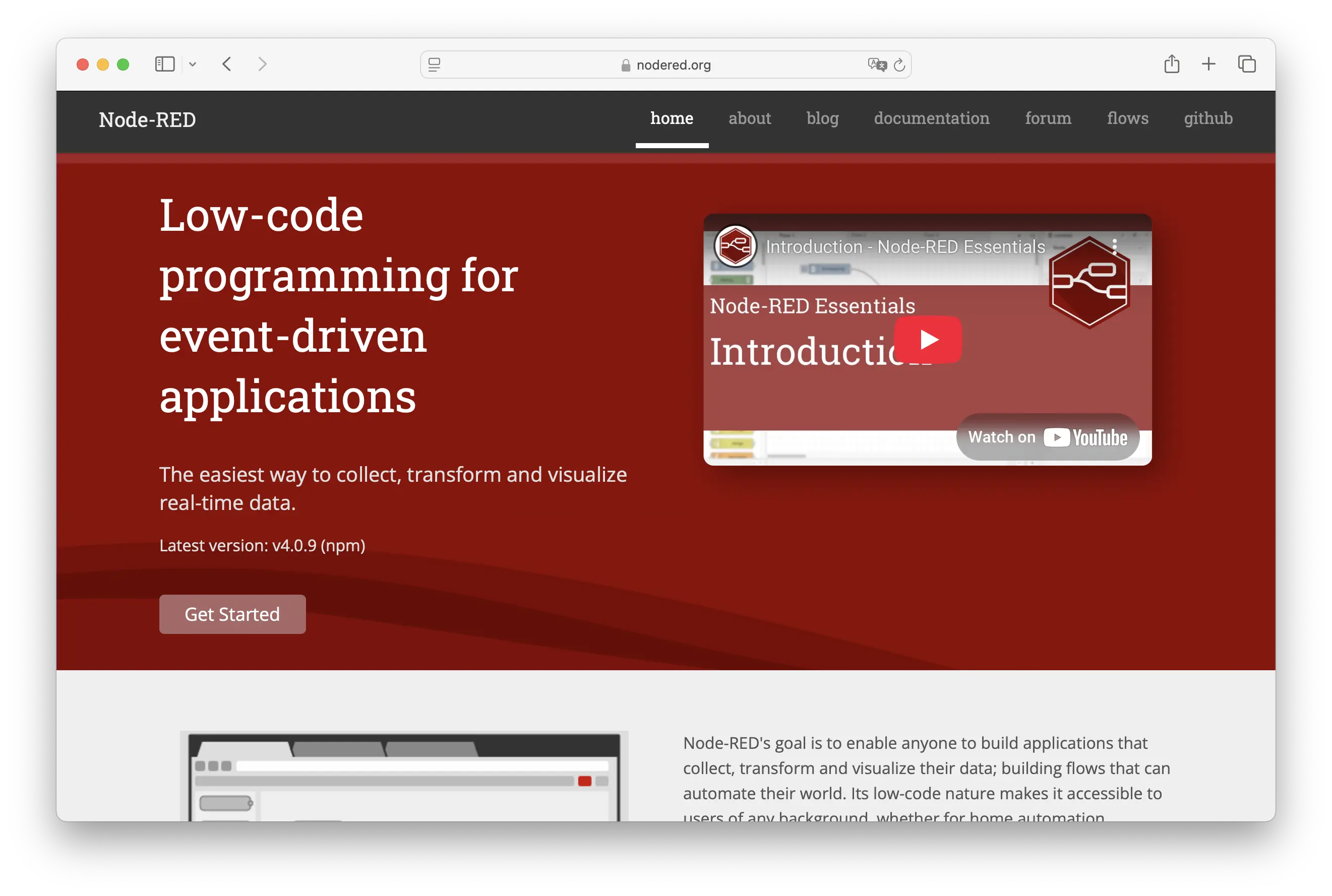
Node-RED is a fully open-source, flow-based programming tool. Originally built by IBM for IoT use cases, it's evolved into a general-purpose automation engine. You wire together "nodes" in a visual editor to create workflows — and with a massive community node library, you can connect just about anything.
The key difference from Zapier: Node-RED is 100% free and self-hosted. No subscription, no task limits, no vendor lock-in. You own everything. The trade-off is that you need to set it up and maintain it yourself, but if you use Sliplane, that part becomes trivial.
- Features: Flow-based visual editor, custom JavaScript functions, huge community node library, MQTT/IoT protocol support, fully self-hosted, API endpoints.
- Why You Should Use It: If you want completely free, self-hosted automation with maximum flexibility. Especially strong for IoT and hardware integration use cases.
- Why Not: Steep learning curve compared to Zapier, limited native SaaS integrations (relies on community-contributed nodes), and requires setup and ongoing maintenance.
- Pricing: Free (Apache 2.0, fully open source).
Conclusion
| Tool | Features | Ease of Use | Integrations | Pricing |
|---|---|---|---|---|
| n8n | Visual builder, AI nodes, code | Moderate, low-code | 400+ apps | Free (self-hosted); $24/mo cloud |
| Make | Visual builder, advanced logic | Moderate, no-code | 1,500+ apps | Free (1,000 ops); from $9/mo |
| Latenode | AI copilot, custom nodes | Moderate, low-code | Growing library | Free tier; from $17/mo |
| Pipedream | Code customization, event triggers | Hard, pro-code | 1,000+ apps | Free (10,000 credits); from $19/mo |
| Node-RED | Flow-based, custom JS, IoT | Hard, low-code | Community-driven | Free (self-hosted) |
Each tool fits a different use case: n8n for open-source power with AI, Make for visual control without code, Latenode for AI-assisted automation, Pipedream for developers who want real code, and Node-RED for free self-hosted automation. If you're hitting Zapier's pricing wall or need more customization, any of these are worth a serious look.
Cheers,
Lukas, Co-Founder sliplane.io