
5 Ways to Deploy Metabase in 2026
 Atakan Öztarak
Looking for the best way to deploy Metabase, the open-source business intelligence platform? Whether you need a quick production setup, want full control over your infrastructure, or just need to test it locally, there's an option for you.
Metabase has 40,000+ GitHub stars and is used by over 60,000 companies worldwide. It lets anyone on your team ask questions about data and get answers as dashboards, charts, and tables, no SQL required. The best part? You have multiple deployment options depending on your needs, budget, and technical expertise.
In this guide, I'll walk you through 5 different ways to deploy Metabase, from the simplest one-click deployment to enterprise-grade Kubernetes setups. Want the quick summary? Skip to the comparison table at the end.
Quick Picks
| Route | Choose it when |
|---|---|
| Sliplane | You want Metabase live quickly with automatic HTTPS, persistent storage, and no VPS maintenance |
| VPS + Docker | You want the lowest raw infrastructure cost and are comfortable operating the server |
| Local Docker | You are testing Metabase or building a demo |
| Kubernetes | Your company already runs apps on Kubernetes and has platform engineers |
| Metabase Cloud | You want the vendor to manage everything and accept SaaS pricing |
Let's get into it.
1. Sliplane - The Easy Way
If you want the simplest and most cost-effective way to self-host Metabase in production, Sliplane is your answer. Deploy Metabase in under 2 minutes with just a few clicks. No server management, no Docker knowledge required.
Here's how fast it is:
Sliplane is a Platform-as-a-Service (PaaS), giving you the best of both worlds: ease of use and affordable pricing.
How it works:
- Sign up at sliplane.io (free GitHub login)
- Create a server (or use the free 48-hour trial server)
- Click "Deploy Service" and select the Metabase preset
- Done! Your Metabase instance is live with automatic HTTPS
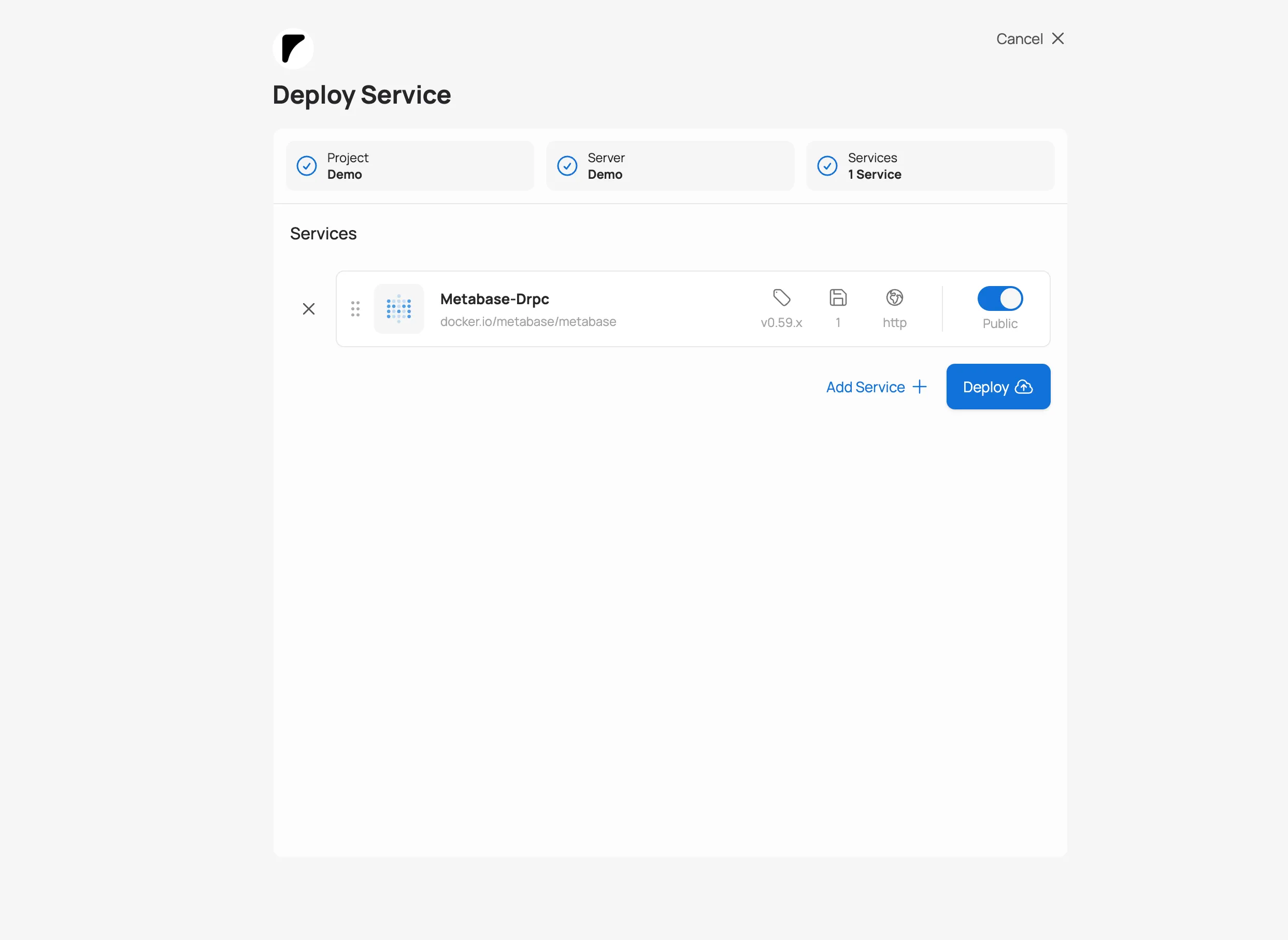
The preset automatically configures a persistent database so your dashboards and settings survive restarts and updates. No need to worry about PostgreSQL setup or volume mounts.
| Category | Rating |
|---|---|
| Complexity | Very Easy: No technical knowledge required |
| Price | €9/month flat, unlimited users |
| Customizability | Medium: Environment variables, volumes, domains |
Pros:
- One-click deployment: No Docker or server knowledge needed
- Fixed pricing: €9/month flat, no per-user fees
- Automatic HTTPS: SSL certificates handled for you
- Easy updates: One-click redeploy to update Metabase
- Unlimited users: No seat-based pricing
Cons:
- No perpetual free tier: 48-hour free trial only
Best for: Developers, startups, and small businesses who want Metabase running in production without the DevOps overhead.
For a detailed walkthrough, check out our guide on self-hosting Metabase the easy way.
2. Self-Hosted on a VPS - The DIY Way
For developers who love full control and want the absolute lowest cost, self-hosting Metabase on a Virtual Private Server (VPS) is the way to go. Providers like Hetzner, DigitalOcean, or Linode offer affordable servers where you can run Metabase with Docker.
How it works:
- Rent a VPS (e.g., Hetzner CX22 for ~€4/month)
- Install Docker and Docker Compose
- Set up a reverse proxy (Caddy or Nginx) for HTTPS
- Deploy Metabase with PostgreSQL using Docker Compose
- Configure DNS and point your domain
Here's the Docker Compose setup you'll use:
services:
  metabase:
    image: metabase/metabase:v0.59.x
    container_name: metabase
    restart: always
    ports:
      - "3000:3000"
    environment:
      MB_DB_TYPE: postgres
      MB_DB_DBNAME: metabaseappdb
      MB_DB_PORT: 5432
      MB_DB_USER: metabase
      MB_DB_PASS: CHANGE_ME_TO_A_SECURE_PASSWORD
      MB_DB_HOST: postgres
    depends_on:
      - postgres

  postgres:
    image: postgres:16
    container_name: metabase_postgres
    restart: always
    volumes:
      - metabase_postgres_data:/var/lib/postgresql/data
    environment:
      POSTGRES_USER: metabase
      POSTGRES_PASSWORD: CHANGE_ME_TO_A_SECURE_PASSWORD
      POSTGRES_DB: metabaseappdb

volumes:
  metabase_postgres_data:
The Metabase Docker image version
v0.59.xwas current at the time of writing. Check Docker Hub for the latest stable version.
We have a complete step-by-step guide with screenshots: Self-hosting Metabase on Ubuntu 24.04 with PostgreSQL
| Category | Rating |
|---|---|
| Complexity | Intermediate: Docker, Linux, networking knowledge |
| Price | €3-10/month (cheapest option) |
| Customizability | High: Full SSH access, any configuration |
Pros:
- Cheapest option: As low as €3-5/month on Hetzner
- Full control: SSH access, custom configurations, any OS
- No vendor lock-in: Move to any provider anytime
- PostgreSQL included: Production-ready database from the start
Cons:
- Manual setup required: Docker, reverse proxy, SSL, firewall
- You handle everything: Updates, backups, security patches
- Time investment: Initial setup takes 30-60 minutes
- Debugging is on you: No support if something breaks
Best for: Developers with Linux/Docker experience who want maximum cost savings and enjoy managing their own infrastructure.
3. Local Development - The Testing Way
Need to evaluate Metabase or test it against your data? Running it locally on your laptop is the fastest way to get started. No server needed, no costs involved.
How it works:
# Using Docker (one command!)
docker run -d -p 3000:3000 --name metabase metabase/metabase:v0.59.x

# Open http://localhost:3000
No persistent storage: This one-command setup doesn't use volumes, so all your dashboards, questions, and settings will be lost when you remove the container.
This uses the default H2 embedded database, which is fine for testing. For a more realistic local setup with PostgreSQL, create a compose.yml:
services:
  metabase:
    image: metabase/metabase:v0.59.x
    container_name: metabase
    ports:
      - "3000:3000"
    environment:
      MB_DB_TYPE: postgres
      MB_DB_DBNAME: metabaseappdb
      MB_DB_PORT: 5432
      MB_DB_USER: metabase
      MB_DB_PASS: metabase
      MB_DB_HOST: postgres
    depends_on:
      - postgres

  postgres:
    image: postgres:16
    container_name: metabase_postgres
    volumes:
      - metabase_postgres_data:/var/lib/postgresql/data
    environment:
      POSTGRES_USER: metabase
      POSTGRES_PASSWORD: metabase
      POSTGRES_DB: metabaseappdb

volumes:
  metabase_postgres_data:
Then run:
docker compose up -d
The default H2 database is fine for testing, but it can corrupt under heavy use and doesn't support easy backups. For production, always use PostgreSQL. See our full Ubuntu guide for a production-ready setup.
| Category | Rating |
|---|---|
| Complexity | Easy: Just need Docker installed |
| Price | Free, no hosting costs |
| Customizability | High: Full local control |
Pros:
- Completely free: No hosting costs
- Instant setup: One command to start
- Great for testing: Experiment without consequences
- Development friendly: Test Metabase API integrations locally
Cons:
- Not for production: Your laptop isn't a server
- No public access: Others can't reach your instance
- H2 database risk: Default database can corrupt under load
- Resource usage: Metabase + PostgreSQL uses your laptop's CPU/RAM
Best for: Developers who want to evaluate Metabase, test data connections, or experiment with dashboards before committing to a hosting solution.
4. Kubernetes - The Enterprise Way
For organizations with existing Kubernetes infrastructure or those needing enterprise-grade scalability and high availability, deploying Metabase on K8s is an option.
But before you go down this path: Read our article on why Kubernetes probably isn't for you. For most teams, it's massive overkill. Also check out Docker vs Kubernetes to understand the key differences.
How it works:
apiVersion: apps/v1
kind: Deployment
metadata:
  name: metabase
spec:
  replicas: 2
  selector:
    matchLabels:
      app: metabase
  template:
    metadata:
      labels:
        app: metabase
    spec:
      containers:
      - name: metabase
        image: metabase/metabase:v0.59.x
        ports:
        - containerPort: 3000
        env:
        - name: MB_DB_TYPE
          value: "postgres"
        - name: MB_DB_DBNAME
          value: "metabaseappdb"
        - name: MB_DB_PORT
          value: "5432"
        - name: MB_DB_USER
          valueFrom:
            secretKeyRef:
              name: metabase-db-credentials
              key: username
        - name: MB_DB_PASS
          valueFrom:
            secretKeyRef:
              name: metabase-db-credentials
              key: password
        - name: MB_DB_HOST
          value: "metabase-postgres"
---
apiVersion: v1
kind: Service
metadata:
  name: metabase
spec:
  selector:
    app: metabase
  ports:
  - port: 80
    targetPort: 3000
  type: ClusterIP
You'll also need:
- A PostgreSQL deployment (or managed database like RDS/Cloud SQL)
- Kubernetes Secrets for database credentials
- Persistent Volume Claims for PostgreSQL data
- Ingress controller for HTTPS
| Category | Rating |
|---|---|
| Complexity | Very Complex: K8s expertise required |
| Price | €70-200+/month (managed K8s clusters aren't cheap) |
| Customizability | Very High: Full infrastructure control |
Pros:
- High availability: Multiple replicas, auto-healing
- Enterprise-ready: Fits into existing K8s workflows
- Infrastructure as code: GitOps-friendly deployments
Cons:
- Massive overkill for most teams. You probably don't need this
- Complex setup: Requires K8s expertise
- Expensive: Managed K8s clusters aren't cheap
- Operational overhead: More moving parts = more things to break
Best for: Large enterprises with dedicated DevOps teams who already run Kubernetes and need to integrate Metabase into their existing infrastructure.
5. Metabase Cloud - The Official Way
Don't want to self-host at all? Metabase Cloud is the official managed service. The Metabase team handles everything: hosting, updates, backups, and support.
How it works:
- Sign up at metabase.com
- Choose a plan (Starter, Pro, or Enterprise)
- Connect your data sources and start building dashboards
Current pricing (as of February 2026):
| Plan | Price | Included Users |
|---|---|---|
| Starter | $85/month | 5 users (+$5 per additional) |
| Pro | $500/month | 10 users (+$10 per additional) |
| Enterprise | Custom | Custom |
| Category | Rating |
|---|---|
| Complexity | Very Easy: Just sign up and use |
| Price | $85+/month (most expensive option) |
| Customizability | Low: Limited to what they offer |
Pros:
- Zero maintenance: Metabase team handles everything
- Official support: Direct help from the creators
- Always up-to-date: Automatic updates with latest features
- Managed backups: Data safety handled for you
Cons:
- Most expensive option: Starts at $85/month for just 5 users
- Per-user pricing: Costs scale fast with team size (a 50-user team on Pro pays $900/month)
- Data on their servers: Less control over data residency
- Interactive embedding: Only available on Pro ($500/month) and above
Compare that to Sliplane at €9/month with unlimited users and no per-seat fees. For a 10-person team, that's €9/month vs $85+/month.
Best for: Teams who don't want any technical responsibility and are okay paying premium prices for a fully managed experience with official support.
Comparison Table
Here's a quick summary to help you choose:
| Feature | Sliplane | VPS (Self-Hosted) | Local | Kubernetes | Metabase Cloud |
|---|---|---|---|---|---|
| Complexity | Very Easy | Intermediate | Easy | Very Complex | Very Easy |
| Setup Time | 2 minutes | 30-60 minutes | 1 minute | Hours/Days | 5 minutes |
| Monthly Cost | €9+ | €3-10 | Free | €70-200+ | $85+ (5 users) |
| Customizability | Medium | High | High | Very High | Low |
| Maintenance | Managed | You handle it | N/A | You handle it | Managed |
| HTTPS/SSL | Automatic | Manual setup | N/A | Manual setup | Automatic |
| Updates | One-click | Manual | Manual | Manual | Automatic |
| Scalability | Good | Manual | N/A | Excellent | Good |
| Data Control | Your server | Full control | Full control | Full control | Their servers |
| User Limits | Unlimited | Unlimited | Unlimited | Unlimited | Per-seat pricing |
| Best For | Most users | DIY enthusiasts | Testing | Enterprises | Non-technical |
Which Should You Choose?
Let me make it simple:
- Want the best balance of ease and cost? Sliplane: One-click deploy, €9/month, unlimited users, no DevOps needed
- Want the absolute cheapest option? VPS Self-Hosting: €3-5/month, but you manage everything
- Just want to test it out? Local Docker: Free, instant, no commitment
- Running a large enterprise with K8s? Kubernetes: Only if you already have the expertise
- Don't want to touch any infrastructure? Metabase Cloud: Pay premium for zero maintenance
For 90% of users, Sliplane offers the best value: production-ready deployment in under 2 minutes, predictable pricing, unlimited users, and zero server management. You get the cost benefits of self-hosting without the headaches.
Not sure if Metabase is the right BI tool for your team? Check out our comparison of 5 open-source Metabase alternatives to see how it stacks up.
Cheers, Atakan